- Aug 11
- Par Pecron LLC

Running a refrigerator, microwave, power tool, or air conditioner away from the grid with a portable power station is entirely possible—but choosing a battery by capacity alone is a common and costly mistake. The system also has to deliver enough continuous power, absorb startup surges, and recharge fast enough to support the way you actually use it.
This guide explains how to size a portable power station or solar generator for high-wattage appliances, estimate realistic runtime, and avoid the problems that make an otherwise capable off-grid setup shut down unexpectedly.
The Short Answer: Can a Solar Generator Run High-Wattage Appliances?
Yes, provided all four of the following conditions are met:
· The inverter’s continuous AC output is higher than the combined running wattage of the appliances used at the same time.
· The inverter can handle the brief startup surge from motors and compressors.
· The battery has enough usable energy for the required runtime.
· The system can be recharged reliably through solar, AC, a vehicle, or a combination of sources.
A 5,000Wh battery may offer long runtime, but it still cannot run a 3,500W appliance if its inverter is limited to 2,000W. The reverse is also true: a powerful inverter paired with a small battery may start the appliance successfully but run it for only a short time.
Start With Three Numbers: Watts, Surge Watts, and Watt-Hours
Before comparing power stations, check the appliance label, manual, or manufacturer’s specification sheet for these values.
Running watts
Running watts describe the power an appliance uses while operating. Resistive devices such as kettles, coffee makers, space heaters, and hair dryers often draw close to their full rated wattage whenever they are on.
Startup or surge watts
Appliances with compressors or motors may need much more power for a few seconds when they start. Refrigerators, air conditioners, water pumps, and some power tools fall into this category. If the inverter cannot supply that surge, it may overload even though the appliance’s normal running wattage appears compatible.
Watt-hours
Watt-hours (Wh) measure energy rather than power. A 1,000W microwave used for 12 minutes consumes about 200Wh; a 150W refrigerator averaging six hours of compressor runtime consumes about 900Wh. This difference between watts and watt-hours is central to accurate battery sizing.
Typical Power Needs of Common Off-Grid Appliances

Actual consumption varies by model, setting, temperature, and duty cycle. Use the table as a planning reference, then verify the rating and, when possible, measure the appliance with a plug-in power meter.
|
Appliance |
Typical running load |
Main sizing concern |
|
Refrigerator |
100–800W |
Compressor startup surge and overnight runtime |
|
Microwave |
1,000–1,800W |
Input wattage may exceed the advertised cooking wattage |
|
Coffee maker |
600–1,500W |
High heating load, usually for a short period |
|
Circular saw / shop tool |
1,000–2,400W |
Motor surge and intermittent heavy load |
|
Window air conditioner |
500–1,500W |
Startup surge, long runtime, and hot-weather demand |
|
Electric space heater |
750–1,500W |
Continuous energy use drains batteries quickly |
|
Well or transfer pump |
500–2,000W+ |
Motor surge; voltage requirements vary |
Important: These figures are general estimates for reference only. Actual power consumption varies by model and operating conditions. Please consult the appliance manufacturer or supplier for accurate specifications, and confirm whether the appliance requires 120V or 240V output.
How to Calculate the Portable Power Station Size You Need

1. List everything you plan to run
Record each appliance’s running watts, startup watts, expected daily runtime, and voltage. Also mark which devices may operate at the same time. Simultaneous use determines the inverter requirement; total daily use determines the battery requirement.
2. Calculate daily energy use
Use this basic formula:
Appliance watts × hours of use = watt-hours per day
For appliances that cycle on and off, use measured daily consumption if available. Multiplying a refrigerator’s rated wattage by 24 hours usually overstates its actual energy use because the compressor does not run continuously.
Example daily load:
|
Load |
Calculation |
Daily energy |
|
Refrigerator |
150W × 6 hours |
900Wh |
|
Microwave |
1,200W × 0.2 hours |
240Wh |
|
Coffee maker |
900W × 0.17 hours |
153Wh |
|
Lights and internet |
100W × 8 hours |
800Wh |
|
Total |
|
2,093Wh |
3. Allow for conversion losses and a safety margin
The battery’s rated capacity is not the same as the energy that reaches an AC appliance. The inverter, wiring, temperature, standby consumption, and battery management system all introduce losses. For preliminary planning, divide the required appliance energy by an assumed system efficiency rather than treating every rated watt-hour as usable.
Using 85% as a conservative planning assumption:
2,093Wh ÷ 0.85 = approximately 2,462Wh
A further 15–25% reserve can help cover colder weather, battery aging, unexpectedly long runtimes, or a day with weaker solar production. In this example, a system around 3,000Wh would be a more comfortable starting point than a 2,000Wh unit.
4. Check continuous output and surge capability
Add the running wattage of the appliances that may operate simultaneously. Then identify the largest likely startup surge. If a 1,200W microwave is running when a refrigerator compressor starts, the inverter must handle both loads at once—not just each appliance separately.
5. Confirm voltage and outlet compatibility
Most portable appliances use 120V in North America, while some well pumps, dryers, workshop tools, and home circuits require 240V output. A high wattage rating does not automatically mean a power station provides 240V. Confirm voltage, outlet type, frequency, grounding requirements, and any transfer equipment before connecting a load.
Plan the Recharge Side, Not Just the Battery
A battery can only support off-grid living if you have a practical way to replace the energy used each day. For solar charging, daily production depends on panel wattage, usable sun hours, temperature, shading, panel angle, wiring losses, and the power station’s solar input limits.
A simple planning estimate is:
Solar panel wattage × peak-sun hours × system factor = estimated daily solar energy
For example, 1,000W of panels receiving five peak-sun hours at a 75% planning factor may produce roughly 3,750Wh in a day. This is an estimate, not a guarantee; clouds, partial shade, seasonal sun angle, and input clipping can reduce production substantially.
Check these charging specifications before buying:
· Maximum solar input wattage
· Supported solar voltage and current range
· AC charging speed
· Whether AC and solar charging can be combined
· Available vehicle-charging options
· Whether the system can power loads while charging
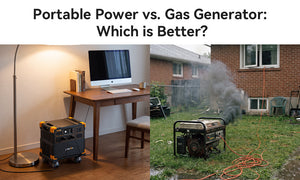
Portable Power Station vs. Fuel Generator Off-Grid
Battery systems and fuel generators solve different problems. In many setups, they can also complement one another.
|
Factor |
Portable power station / solar generator |
Fuel generator |
|
Noise |
Quiet apart from cooling fans |
Engine noise during operation |
|
Indoor use |
No combustion exhaust during normal operation |
Must remain outdoors and safely away from doors, windows, and vents |
|
Maintenance |
Generally low routine maintenance |
Engine, oil, fuel, and storage maintenance |
|
Energy supply |
Stored electricity; rechargeable from compatible sources |
Runs while a suitable fuel supply is available |
|
Solar integration |
Common and direct on many models |
Usually indirect |
|
Best fit |
Quiet daily use, RVs, cabins, tools, and backup loads |
Long outages or extended high loads when fuel is accessible |
Never operate a fuel generator indoors, in a garage, or near openings into an occupied space. Carbon monoxide can build up quickly even when doors or windows are open.
How to Get More Runtime From an Off-Grid Power System
· Run energy-heavy tasks during strong solar production so part of the load is supplied directly by incoming power.
· Avoid using several heating appliances at once. Electric heaters, kettles, hot plates, and hair dryers consume large amounts of energy quickly.
· Pre-cool refrigerators and freezers while charging is abundant, then minimize door openings overnight.
· Use efficient appliances, LED lighting, and lower-power cooking methods when practical.
· Monitor actual consumption in the power station app or with a power meter and update your estimates.
· Keep vents clear and operate the system within the manufacturer’s temperature limits.
Common Mistakes to Avoid
Sizing only by battery capacity
Capacity determines potential runtime; inverter output determines whether an appliance can run at all. Both must be checked.
Ignoring startup surge
Motor-driven loads may briefly demand far more than their running wattage. Look for the appliance’s starting requirement and the power station’s surge specification, including any time limit attached to that rating.
Assuming every rated watt-hour is usable
AC conversion and system overhead reduce delivered energy. Cold temperatures and high loads can reduce practical runtime further.
Using nameplate power to estimate cycling loads
Refrigerators and air conditioners cycle. A plug-in meter or the appliance’s published annual energy use usually gives a better estimate than multiplying maximum wattage by 24 hours.
Overestimating solar production
Panel ratings describe controlled test conditions. Real output changes throughout the day and year, so design around local conditions and keep a backup charging plan when power is essential.
Choosing the Right System for Your Use Case
For an RV or weekend cabin
Prioritize portability, useful outlet selection, efficient standby operation, vehicle charging, and enough capacity for refrigeration and overnight essentials.
For a remote workshop
Focus on continuous AC output, motor surge performance, 120V/240V requirements, and solar or AC recharge speed between work sessions.
For off-grid home or emergency backup
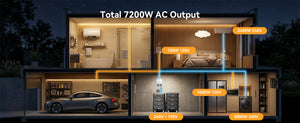
Look for expandable battery capacity, high solar input, appropriate voltage output, a clear method for connecting selected household loads, and installation support where required. Permanent home integration should be completed with suitable transfer equipment and a qualified electrician in accordance with local codes.
If your needs span several categories, an expandable portable power station can provide a more flexible starting point than a fixed-capacity unit. Explore PECRON portable power stations and solar generator kits to compare battery capacity, output voltage, solar input, and expansion options for different off-grid loads.
Final Checklist
· Verify each appliance’s running watts, startup watts, voltage, and daily runtime.
· Add the loads that may run at the same time.
· Calculate daily watt-hours and allow for conversion losses and reserve capacity.
· Confirm continuous output, surge performance, voltage, frequency, and outlet compatibility.
· Make sure the available charging sources can replace your average daily energy use.
· Measure real consumption whenever possible and adjust the plan before adding more loads.
A reliable off-grid system is not necessarily the one with the biggest battery or highest advertised wattage. It is the one that balances output, usable energy, recharge capability, and the way your appliances actually operate.
Frequently Asked Questions
Can a portable power station run a refrigerator?
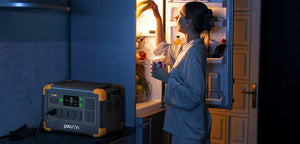
Yes, if its inverter can handle the refrigerator’s compressor startup surge and its battery has enough usable energy for the required runtime. Measure the refrigerator over at least 24 hours for a more accurate estimate.
What size solar generator do I need for a microwave?
Check the microwave’s electrical input rating, which can be higher than its advertised cooking output. The solar generator’s continuous AC output should exceed that input load, while battery capacity determines how many minutes of cooking it can support.
Can a solar generator run an air conditioner?
Many can, but the answer depends on the air conditioner’s running watts, startup surge, voltage, thermostat cycle, and desired runtime. Air conditioning is energy intensive, so sufficient battery capacity and strong daily recharging are essential.
How long will a 2,000Wh power station run a 1,000W appliance?
The theoretical result is two hours, but actual runtime will be shorter because of inverter losses, system overhead, temperature, and other conditions. At an assumed 85% overall efficiency, a rough planning estimate is about 1.7 hours.
Can I use a solar generator while it is charging?
Many portable power stations support pass-through operation, but power limits and battery behavior vary. Check the manual for the model’s supported charging and output combinations before relying on it continuously.
Do I need 240V output off-grid?
Only if the appliance or circuit requires it. Some well pumps, large tools, dryers, and home systems use 240V. Confirm both voltage and outlet compatibility; wattage alone is not enough.